Tall palms and the shorter palm like cordylines are essential features of the garden landscapes inherited from the moors. However many palms are being attacked by palm weevils for which there is as yet no cure.
There are dramatic flowering trees for all seasons.
The earliest being the almond and winter flowering wattle/acacia followed by the mexican flame, Judas and orange trees around Easter. Early spring is also the time of the dramatic blue flowered jacaranda, pink tamarix and large white flowered evergreen magnolia. Summer brings out the exotic flowers of the bead, bird of paradise/devil’s tongue, silk, orchid and grape myrtle trees while the most exotic of all the deep pink and white flowered varieties of the floss-silk /chorisia tree grace gardens even lining the drives of larger properties through late summer and autumn.
Bougainvilleas are undoubtedly among the most spectacular whether trained up house or boundary walls, over gazebos or trimmed as hedges. We will never forget some of the four or five metre hedges of mixed reds, pinks, oranges, yellows and whites that we have passed by. The hardiest and most compact growing purple bracted glabra variety can be pruned as standards and into other topiary shapes.
Bignonias are another group of colourful climbers but growing more rampant than bougainvilleas and therefore not used for hedges. There are spring summer and autumn flowering varieties.
Other favourites are exotically coloured south American passion flowers, mandevillas/dipladenias, and jasmine – especially the most perfumed pink tinted variety. The latter often planted alongside entrance gates to give a special Spanish welcome to guests.
Our favourites fall into two categories. Those that flower for most months of the year and some outstanding seasonal plants.
The long flowering bushy shrubs include hibiscus, lantanas, oleanders, angels trumpets. Each come in a range of hot colours – reds, oranges and yellows – and more subtle pinks, creams and whites. All can be planted as individual specimens or as colourful hedges. Lantanas are among the longest continuously flowering shrubs and in our view are preferable to short seasoned roses. Although very characteristic of Spain the latter are best assigned to a dedicated side garden.
Spring flowering gems include the squat and spire like blue, white and if lucky red flowered varieties of the Pride of Madiera echiums and red flowered bottle brushes.
Summer special effects include the highly perfumed frangipanis and the lady of the night, continuously flowering plumbagoes and the marmelade bush streptosolens, while the yellow spires of cassias add distinction to summer and autumn flower beds and banks.
The most reliable and exotic include the long flowering lion’s ear/leonotis, African daisies, pineapple and candelabra sages, lavenders, cascading rosemary and of course geraniums/pelargoniums.
Naturally many succulents, cacti and agaves thrive in the hot dry climate. Although the six metre high flowers of the agave century plant only appear after eight to ten years other varieties will flower annually. Our favourites include aeoniums whose yellow conical shaped rosettes of flowers are held high above the exotic leaves around Christmas time, the colourful flowered aloes including the medicinal aloe vera, the orange red flowered cotyledons, the red flowered cabbage like echeverias and the exotic flowered epicactus and orchid cactus/epiphyllum -even though the flowers of the last two wither in less than a day.
Ground cover plants are important for continuity of colour from trees, shrubs and perennials to pathways and terraces, for covering banks and underplanting trees. In each case spreading low growing plants such as purple and white flowered lantanas, messems and giant pig face help reduce the extent of capillary evaporation from the sun baked surface of otherwise exposed soils.
Hedges are still important along the coast to give shelter from hot winds from North Africa, storm carried salt, security and privacy. Many property owners opt for something more exotic than the very serviceable cypress and good for nothing/gandula hedges by planting flowering hedges. Among the most popular are bougainvilleas, hibiscus, oleander, lantana, bitter orange and the Japanese mock orange, pittosporum – the latter three being pleasantly perfumed. Prickly pear cacti hedges will still be seen in undeveloped areas acting as a firebreak, intruder/animal deterrent and a source of fruit for jams and liquors.
One of the main advantages and indeed thrills of the most sheltered gardens within the subtropical coastal strip is that exotic fruits can be grown. These include avocados, bananas, dates, guavas, lychees, mangoes, nisperos, papayas, macadamia and pistachio nuts and even pineapples can be successfully grown as well as delicious figs, sweet Moscatel grapes and the full range of citrus fruits – oranges, mandarins, grapefruits, kumquats, limes, lemons.
Perpetual lemon trees that flower every six to eight weeks are very popular as they bear yellowing lemons throughout the year. Some call them the ‘gin and tonic’ trees!
Unfortunately many bulbs that grow in inland Spain suffer along the coast from slug and worm attacks during the drier months. However clumps of Agapanthus, Madonna and Asiatic lilies and society garlic (grown in rich, damp and semi shaded conditions) can be summer eye stoppers as are clumps of Dutch and Spanish irises and freesias in the spring.
One of the delights of living in Spain is that the house plants one grew in centrally heated rooms and conservatories in Ireland are grown in the garden, courtyards and patios and on apartment terraces. Albeit often in pots and in semi shade or areas shaded for a good part of the day during the summer months and with regular watering – sometimes twice a day. Popular plants include aspidistras, bromeliads, orchids, flamingo flowers, codiaeums, snake plants and stag horn ferns.
They have not been forgotten but do not have the pride of place in Spanish coastal gardens where many are burnt up by the scorching summer suns even if watered twice a day. The most reliable in semi shaded but still hot summer positions are petunias, sun plant/portulacas, zinnias and busy lizzies. For winter months petunias, pansies and violas tend to be the favourites.
Growing plants in pots and containers is the one activity most of us over here share. It doesn’t matter if your garden is large or small, patio or soil, we can all use them. No empty space is wasted and any opportunity to brighten up an area should be taken.
It is possible to use anything that holds any amount of soil, so long as it has drainage holes. You gain the best effect from suiting a container to its site and the job it must do.
 As a feature, I built a flower pot man using old plastic flower pots of varying sizes, larger for the body and head, getting smaller for arms, legs and feet. I used threaded metal bar with nuts and washers to shape the features.
He was about 6 feet tall. I attached his hands to a wheelbarrow, shaping arms and legs to assume a pushing position. When he was in position, we filled the barrow with soil and planted it up with a bright selection of bedding plants. I did make sure the barrow had drainage holes first. This became a great feature and was a good use for old pots.
On another occasion, as a feature for one of our gardens we built a seating area with a central metal frame in the shape of an umbrella. All the spines of the central frame had a hook.
We attached hanging baskets to each hook, all at different levels. We threaded plastic tubing along the spines, letting us connect to a watering system. The bright array of bedding plants from the baskets gave a massive hit of colour and was quiet a talking point. 1 think our idea was adopted by manufacturers, unfortunately didn’t get any patenting rights!
You do not need to spend a fortune on suitable pots. Sometimes just look around your garden or shed, it is surprising what you have laying around. The second-hand shops are a great place to find things. Look with an open mind, with a lick of paint, its surprising of the effect you can make. The garden centres have a vast range of pots and they are not overly expensive, just look around for best buys.
If you are feeling creative, inexpensive plastic containers are easily transformed with a coat of matt-finish acrylic paint to give a splash of colour. If the plant you intend to grow
in the container is flowery, decorate the pot more discreetly with sponging. If you want to go all out, you could use stencilling.
Movable containers such as an old wheelbarrow could have Argyanthemum fruitescens, pink pelargoniums, brilliant yellow caceolaria and trails of ivy foliage to set off the display.
Suitable for old sinks, or similar containers could be Alpines or other dwarf plants. These would be lost elsewhere in the garden. Set among fern fronds of Dryopteris, Aquilegia bertolonii and Iris graminea.
More elegant containers such as a stone urn can look amazing with the simplest of planting. Variegated ivy appears almost golden in the sunshine, maintaining its good looks throughout the year with almost no attention or effort on your part.
On a personal note, I have very little soil in the garden, mainly tiles and gravel. To give the planting different heights and interest, I have raised some pots on old railway sleepers, putting climbing plants towards the back to climb up the fence. Then more colourful plants such as geraniums and sorbus reducta interspersed with different coloured grasses. Grouping them like this helps to stop them drying out too much and gives a bit more interest around the back of the pool.
Spain is Europe’s largest producer of garlic, and the fourth largest in the world. Garlic, whose Latin name is Allium Sativum, comes from the same family as onions, chives, shallots, and leeks. It differs in that it has hardly any flowers and no stem, so the leaves grow directly from the the underground bulb.
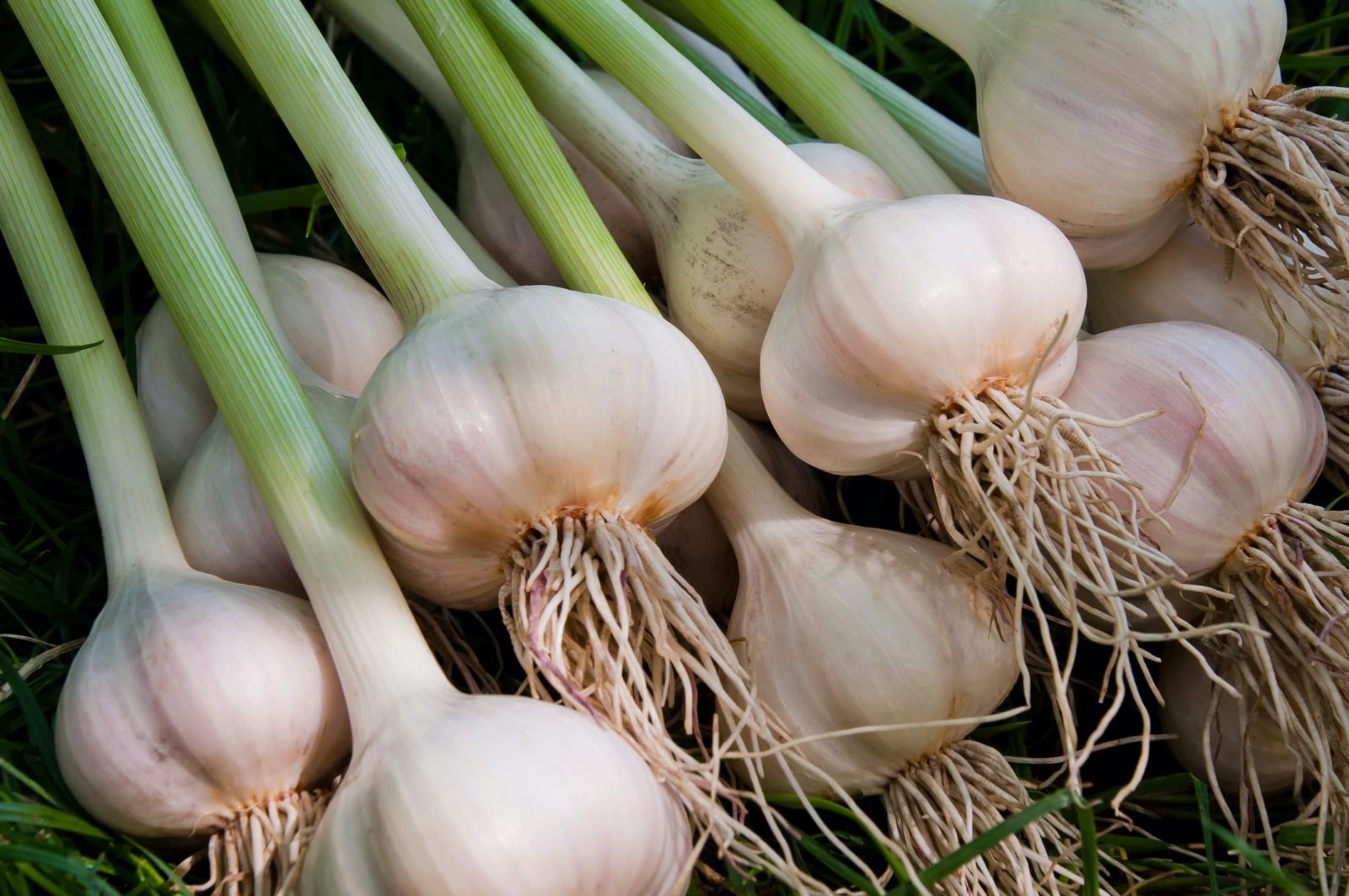 A head of garlic consists of 8-12 bulbs, which are known as cloves. The first garlic was cultivated several centuries ago in central Asia. It quickly spread from there to India and the Mediterranean Sea to Greece where it was used for preventing typhus and cholera. They also gave garlic to their athletes before the Olympic Games to give them strength. However, the first examples of garlic being used for medical purposes come from Ancient Egypt.
The Ancient Egyptians took its curative qualities as a sign of magic powers, and they gave their slaves garlic to keep them strong and healthy. It got to be considered a divine icon, and when a sacred oath was given, garlic was invoked as divinity. Heads of garlic have been found in tombs; it is thought that they were included for keeping evil spirits at bay. During the Roman Empire, garlic started forming part of people’s everyday diet. The Romans also noticed its strong antiseptic powers and it was given to the combat soldiers. The soldiers referred to garlic as ‘malodorous roses’.
From the Roman Empire garlic spread to the rest of Europe and soon became an integral part of the staple European diet. However, garlic has not always been unequivocally loved; the Spanish Queen Isabel La Católica prohibited its use at court, and in the 14th century King Alfonso of Castile hated the smell so much that any knight who had ingested garlic was not allowed to his court for a month.
Today garlic is an integral part of our diet, and those that do not like garlic are few and far between. This is partly because of the different ways garlic can be used; you can add garlic to a dish without anybody noticing a particularly garlicky smell or taste, you can give your dish a whiff or garlic, or you can let it dominate completely. The finer you chop your raw garlic, the stronger the flavour gets.
Crushed or grated garlic gives you the strongest flavour and is used for example in garlic butter, salad dressings and alioli. If you give your clove of garlic a bash, leave the skin on and stick it in a bottle of olive oil together with a twig of rosemary or thyme, you get a divine garlic oil. For stews, whole cloves of garlic with the skin left on add flavour without exaggerating the garlic aspect; those that enjoy the flavour of garlic can slide the garlic out of its skin and eat the creamy clove; it is delicious! If you cook whole, peeled cloves of garlic in, for example soups or mashed potato, you get a sublime garlic flavour without the sharpness of the crushed or grated garlic.
Garlic is good for you. Researchers have found that garlic can help prevent heart and artery disease, and even certain cancers. It has also often been said to help against common cold; this, however, is purely preventative. Studies show that people who eat garlic regularly generally have a lower frequency of common cold, but once the symptoms have set in, garlic will not help relieve them.
Raw garlic has always been considered more medically efficient than cooked garlic, but research shows that it is the overall intake of allium sativum that counts. And for those who want to reap the benefits of garlic but just cannot stand it, there’s always garlic capsules…


